Monday, December 5, 2016

Old-Growth Post Fire Logging Proposed on the Siskiyou Crest!

The Gap Fire near Condrey Mountain is being proposed for post-fire logging despite minimal fire severity. 


The Gap Fire began as a human ignition near Low Gap on the Klamath River above Seiad Valley and the community of Horse Creek on August 27, 2016. The fire spread quickly, pushed by intense downslope winds burning into the community of Horse Creek and destroyed nine homes. After burning through the community of Horse Creek the fire burned upslope toward the Siskiyou Crest in the Horse Creek, Middle Creek and Buckhorn Creek watersheds.

Although a tragedy in Horse Creek, where nine homes burned, the Gap Fire was far from catastrophic and provided great benefit to the habitats in which it burned. The fire burned at 67% low severity, 26% moderate severity and 7% high severity throughout the burn area. The fire burned within the range of variability for wildland fire in the Klamath-Siskiyou Mountains. Burning at mixed severity, the fire had positive effects on fuel loading, landscape scale vegetation mosaics, stand structure, nutrient cycling, species composition, age class diversity and other important stand development and forest resiliency measures.


Low severity fire in upper Buckhorn Creek
Despite the positive effects of the Gap Fire, the KNF has proposed to implement old-growth post fire logging at the headwaters of Buckhorn Creek in a nationally significant habitat connectivity corridor. The KNF has proposed to clearcut 2,257 acres of fire-affected forest in Buckhorn, Middle and Horse Creeks. They are also proposing 103 miles of roadside hazard logging. The sale is proposed in many biologically important areas, including the Johnny O’Neill Late Successional Reserve and the Horse Creek Botanical Area, designated to protect complex old forest habitat. 

The fire also burned adjacent to the Condrey Mountain Blue Schist Geologic Area, the Pacific Crest Trail, the Condrey Mountain Roadless Area and KNF designated Back-Country Area.

Proposed logging units extend from lower Horse Creek near the Klamath River, into Buckhorn Creek and high on the Siskiyou Crest near Condrey Mountain and Dry Lake Mountain. The region is known and renowned for its intact wildland habitats, old-growth forests, mountain meadows, aspen glades, rare and diverse wildflower displays and important wildlife habitat. The area supports the Pacific fisher, large herds of elk, black bear, and was the location of the last reported wolverine siting on the Siskiyou Crest in 1997.

The PCT runs directly above some areas targeting for logging in the Gap Fire post-fire logging project. Given the international acclaim of the PCT, it would be unwise to log so close to the trail. Maintaining a healthy, intact ecosystem along the PCT corridor is consistent with the current and expected future recreational use of the area and and the economic vitality the PCT brings to the region.

The Siskiyou Crest represents one of the most important connectivity corridors and climate refuges in western North America. A transverse range, running east to west, the Siskiyou Crest connects the Oregon and California interior valleys to the Cascade Mountains, the Coast Ranges and the high deserts of the Great Basin. At the center of this connectivity corridor, and on the edge of the region's vast network of unprotected roadless areas and protected wilderness, is Condrey Mountain. Condrey Mountain represents a pinch point in connectivity where heavy industrial logging to the south has eliminated vast swaths of complex forest habitat, replacing it with dense tree plantations and barren clearcut swaths logged in the aftermath of the 2014 Beaver Fire on the Klamath River.


Post-fire logging on Fruit Growers Supply land in the Beaver Fire. This photo is taken directly adjacent to the photo below. 
Unlogged high severity fire in the Beaver Fire of 2014, taken directly adjacent to the photo above. Notice the difference in vegetative recovery.
In 2014, following the Beaver Fire, industrial logging interests such as the Fruit Growers Supply Company (FGS) devastated vast tracts of private timber land, logging fire scorched stands, live trees and patches of fire resilient forest. FGS leveled whole watersheds due east of the Gap Fire Area, creating massive clearcuts thousands of acres wide. The devastation left behind is unmistakable and the cumulative impact unacceptable.

The large denuded slope in this photograph was logged by Fruit Growers Supply Company following the 2014 Beaver Fire and lies directly adjacent to the area burned in the Gap Fire on the Siskiyou Crest.
To make matters worse, FGS is preparing to log off their holdings in the Gap Fire and the KNF is proposing to clearcut thousands of acres of fire-affected forest currently benefiting from natural fire revitalization. The proposed logging project will further exacerbate already significant cumulative impacts to old forest and endangered species habitat, endangered fisheries (coho salmon), soils and future fire hazards on the Klamath River due to recent post-fire logging in the Beaver Fire, Happy Camp Fire, and now, Gap Fire footprints.

The forests of the Condrey Mountain-Dry Lake Mountain area at the headwaters of Buckhorn Creek have been targeted by the KNF with many post-fire logging units, despite sustaining predominantly low severity fire effects. The forests proposed for logging are the last remaining ancient forest habitats in the Buckhorn Creek watershed. The KNF intentionally lit these forests ablaze between September 3 and September 8, 2016 in order to bolster fire containment. They now intend to log the natural fire mosaic, removing massive old trees and the building blocks of forest complexity (e.g. old snags, downed wood, old living trees, etc).

Small snag patches such as this one in upper Buckhorn Creek are being targeted for logging by the KNF. The damage to soils, forest regeneration, and habitat complexity will degrade some of the watershed's only remaining old-growth forest.

Live trees as well as dead trees will be logged. Some units will be treated with ground-based yarding which could severely damage the highly erodible schist soils of the Condrey Mountain area. New "temporary" road will be constructed. 

Many beautiful springs and meadows are located within or adjacent to the logging units, including Buckhorn Spring, a historic campsite and intact native habitat at the very headwaters of Buckhorn Creek.  
The meadows adjacent to Buckhorn Spring are currently surrounded by intact high elevation forest and are proposed for logging by the KNF.

In recent years the KNF has decimated thousands of acres in post-fire logging projects, often following characteristic and natural wildfire events. Although touted as "fire recovery" the projects serve only to produce large volumes of old-growth timber for the industry, while degrading forest habitats, inhibiting natural recovery, filling nearby streams with sediment, creating unnatural plantation stands and drastically increasing future fire hazards. 

Please help these fire-affected forests recover naturally. Provide public comment on the ironically named Horse Creek Community Protection and Forest Restoration Project. 

Talking Points: 
  • Implement only fuel reduction adjacent to the community of Horse Creek, consider the use of prescribed fire and non-commercial fuel treatments.
  • Cancel all post-fire logging units in the Siskiyou Crest connectivity corridor near Condrey Mountain and Dry Lake Mountain.
  • Cancel all post-fire logging units in the Johnny O'Neill Late Successional Reserve.
  • Analyze the cumulative impact of private land logging, public land logging, and discretionary fire suppression impacts such as dozerline and backburning in the Environmental Analysis.
  • Do not implement post-fire logging treatments in forested habitats purposefully backburned by fire suppression crews. 
  • Cancel all post-fire logging units due to extreme cumulative impacts and to compensate for the damage already done on adjacent private timber land. 

Please submit comments to the Klamath National Forest at the following website: 


Tuesday, November 22, 2016

East Applegate Ridge Trail EA Released!

A view south into Ruch from the East Applegate Ridge Trail.
The Applegate Trails Association (ATA) is a non-profit trail organization advocating for non-motorized trails in the Applegate Valley. ATA has been promoting the Applegate Ridge Trail (ART) since 2011. The ART will extend from Jacksonville to Grants Pass and will tie into the Jack-Ash Trail, proposed to connect Jacksonville to Ashland. In total the two trails will cover over 80 miles and will provide appropriate, non-motorized trail access to the beautiful foothills of the Applegate Valley.

The BLM just released the Environmental Assessment (EA) for the East Applegate Ridge Trail, a 5.6-mile portion of trail connecting Sterling Creek Road to Highway 238 near Forest Creek and the town of Ruch. It will be one of the most beautiful non-motorized trails in the Applegate Valley, with its spectacular views, picturesque oak woodland and grassy prairie slopes.

The EA also proposes to obliterate an unauthorized, user-created OHV trail impacting soil resources, botanical resources, wildlife and facilitating private land trespass.

Please support the East Applegate Ridge Trail and ATA. Send a public comment on the East ART EA and support non-motorized recreation in the Applegate Valley. 

Talking Points:

  • Show support for the Applegate Ridge Trail and non-motorized recreation in the Applegate Valley.
  • Ask the BLM to approve the East Applegate Ridge Trail and obliterate the existing unauthorized OHV trail as proposed in the EA.
  • Ask the BLM to expedite the process to analyze and approve the remaining portions of the Applegate Ridge Trail from Highway 238 to Board Shanty Road. Recommend that subsequent EAs be prepared promptly to facilitate speedy development of this important non-motorized trail. This would include the Center ART from Highway 238 to Humbug Creek, the Flank of Old Blue from Humbug Creek to the Enchanted Forest Trail on Slagle Creek, and the West ART from Slagle Creek to Board Shanty Road.
  • Reconsider the RMP designation to remove Lands with Wilderness Characteristics (LWC) in the Wellington Butte Area. Please protect the Wellington Butte LWC.
  • Recommend that the BLM add the eastern China Gulch additions to the Wellington LWC as proposed by ATA and ANN.

Send Written Comments To:

BLM (Attention: Shana McCarty)
3025 Biddle Road
Medford, Oregon 97504

Send Email Comments To:

blm_or_md_mail@blm.gov
(be sure to include Shana McCarty in the subject line)
Bishop Creek Ridge on the East Applegate Ridge Trail.
Join the ATA for an evening in celebration of the Applegate Ridge Trail and the release of "Walking the Wild Applegate" a short documentary film about the first thru hike from Ashland to Grants Pass on the Jack-Ash and Applegate Ridge Trail.

Walking the Wild Applegate- Film Showing!

When: December 9, 2016 6:00 PM
Where: At the Ruch Fire Station Public Meeting Room
              1095 Upper Applegate Road 

Saturday, October 29, 2016

Support Science-Based Expansion of the Cascade-Siskiyou National Monument!

The Horseshoe Ranch Wildlife Area on lower Scotch Creek would be added to the Cascade-Siskiyou National Monument if the proposed expansion is approved. This vital wildlife corridor would be protected by Monument designation, protecting the watershed from its dramatic headwaters at Pilot Rock, to its mouth at soon-to-be-undammed Iron Gate Lake.

At the spectacular collision of the Cascade and Siskiyou Mountains lies a region of transition, contrast and renowned biodiversity. The region provides vital connectivity between the Cascade Mountains, the Siskiyou Mountains, the Coast Ranges of Oregon and California, the high deserts of eastern Oregon, and the interior valleys of southern Oregon and northern California. In essence, the Cascade-Siskiyou region ties together the major plant communities and ecoregions of the west. The mountains are an intriguing mosaic of grasslands, oak woodlands, juniper scrub, chaparral, dry pine forests, moist fir forests, meadows, glades, wetlands, springs and volcanic rock outcrops. The area, although sometimes subtle, is stunningly diverse.

A portion of this region was protected in 2000 as the 53,000-acre Cascade-Siskiyou National Monument. 13,000 acres of private land purchased by conservation interests have been added to the monument in the preceding 16 years, bringing the total to 66,000 acres. The current Cascade-Siskiyou National Monument includes the Soda Mountain Wilderness, 19 miles of the Pacific Crest Trail, 120 butterfly species, 300 species of animals, 200 species of birds and an incredible array of plant species. The existing monument supports populations of the rare Gentner's fritillary (Fritillaria gentneri), the threatened Oregon spotted frog, northern spotted owls, Roosevelt elk, mule deer, grey wolves, and many others. The Jenny Creek redband trout and the Jenny Creek sucker are found nowhere in the world outside the waters of Jenny Creek at the eastern portion of the monument. The landscape is wild, unique and beautiful.

The rugged Jenny Creek Canyon, including the spectacular and remote Jenny Creek Falls, would be protected if the Cascade-Siskiyou National Monument expansion is approved. This would protect one of the region's wildest canyons and the major waterfalls that serve to keep the endemic Jenny Creek redband trout and Jenny Creek sucker isolated and genetically unique.

Currently, the Obama Administration is considering the  designation of a sizable expansion to the the Cascade-Siskiyou National Monument. The proposed expansion would extend to the north and south of the existing National Monument boundary,  including 66,000 acres in the vicinity of Grizzly Peak, the Dead Indian Plateau, Old Baldy and the headwaters of Jenny Creek, as well as lower Scotch Creek, the Horseshoe Ranch Wildlife Area, and the Jenny Creek Canyon in California. The expansion area includes five Areas of Critical Environmental Concern, 17 miles of the Pacific Crest Trail, numerous rare and endemic plant and animal species, significant areas of oak woodland, old growth forests, beautiful meadows and high levels of biodiversity.

The expansion of the Cascade-Siskiyou National Monument would protect the natural resources and intact habitats of the region, provide economic benefits, recreational opportunities and enhance our quality of life in southern Oregon and northern California. Please support a science-based expansion of the Cascade-Siskiyou National Monument. The future of our region depends on it. 


Privately owned land managed for conservation by the Selberg Institute, combined with National Monument expansion in the Sampson Creek area, will protect some of the Rogue River Valley's most beautiful and intact oak woodland.

Consider attending public meetings and speaking out on behalf of monument expansion, writing letters to the editor, and contacting your public officials. Opportunities to support the science-based expansion of the Cascade-Siskiyou National Monument are listed below. Please help us demonstrate grassroots support for expansion and encourage the Obama administration to designate a bigger, wilder, more ecologically functional monument for the future of southern Oregon. 

          Write Letters to Your Elected Officials

 Contact Senator Merkely 
(541) 608-9102
Contact Senator Wyden
(541) 858-5122 

Provide written comment to the Jackson County Commissioners at the following email address: 

 BoC_CAO_Admin@jacksoncounty.org


Attend Public Meetings

Klamath County Commissioners are holding a public hearing to solicit comments on the proposed expansion of the Cascade-Siskiyou National Monument. Please attend and speak out in support of science-based expansion.

When: Tuesday, November 1, at 6:00 PM
Where: Government Center Hearing Room 219 at 
305 Main Street, Klamath Falls

A carpool will be leaving from Ashland at the KS Wild office at 3:00 PM        (3185 East Main, Ashland).  

Submit a Letter to the Editor

Proposed expansion areas are bordered in green. The expanded monument would extend from the Rogue River-Siskiyou National Forest boundary to beyond the California border. 


Wednesday, September 28, 2016

BLM Shelves the Nedsbar Timber Sale — For Now!

Local residents protest the Nedsbar Timber Sale auction on September 22, 2016.
Photo: www.timdawphotography.com

Last week the Medford District BLM proposed to sell the Nedsbar Timber Sale to the highest bidder, offering some of the last roadless forests in the Applegate Valley to private timber interests for $68 per thousand board feet. The agency was offering 3.4 million board feet of public forest for a minimum bid of $231,014.60.

The community of the Applegate Valley believes these intact forests are priceless, and in response organized a large protest at the timber sale auction on Thursday, September 22, 2016. 

With resistance to the sale growing, 75 residents of the Rogue and Applegate Valleys attended the rally, advocating that the BLM withdraw the sale and protect the area's important biological and recreational values.

Photo: www.timdawphotography.com
Protestors held signs, sang songs, held mock timber auctions, shared information about the timber sale, spoke with media and advocated for protection of the area's ecology and recreation-based economy. Some in attendance wanted to witness the process of the auction and tried to enter the auction. These residents were denied access and public timber was auctioned to private interests behind closed doors. 

Residents expressed their concerns about the timber sale and the lack of meaningful collaboration that led to its approval, airing their concerns with BLM officials and filling the lobby of the Medford District BLM Office. Protestors also spread out across the parking lot and along the main street bordering the BLM office, receiving many honks and cheers of approval from passing motorists.  


Photo: www.timdawphotography.com
Following the protest and timber auction, BLM announced that the Nedsbar Timber Sale received no bidders. Having failed to sell, the BLM announced it would re-offer the Nedsbar Timber Sale under a 30-day sealed bidding process, allowing the industry yet another chance to purchase our public forests for private gain.

Within days of this announcement the BLM reevaluated the situation and has now removed the sale from the sealed bidding process. "We're going to pull it back and see if we can work on the economics of it. We'll look at everything to see if there's some tweeks or changes to improve this sale," said BLM spokesperson, Jim Whittington, to the Medford Mail Tribune. 

The timber industry wants a more economical sale and is pressing the agency to repackage Nedsbar into a sale that includes only the most economical units. 

"I don't see anyone coming up and grabbing it the way it is," said Andy Geissler to the Medford Mail Tribune. Andy Geissler is a timber industry lobbyist from the American Forest Resource Council. "Its good to hear it's getting a makeover," he said.

The "makeover" the timber industry is hoping for will likely include either lowering the minimum bid price or reducing the cost of logging by dropping units with low volume per acre. This would leave only the units with the highest timber volumes and largest trees included in the sale. 

Photo: www.timdawphotography.com
The industry would also like to see prescriptions rely less on helicopter logging which is expensive to implement, Geissler said.  

Local residents are also hoping many of the helicopter logging units will be dropped, especially those in roadless areas or fire resilient, late seral stands. Numerous units on Bald Mountain, in the Little Appleagate River canyon, at the head of Grouse Creek and on Boaz Mountain should be removed from the timber sale.

The BLM is analyzing the administrative "protest letters" they received from the Applegate Neighborhood Network (ANN) and others. We hope this analysis will allow the BLM to amend the Decision Record, withdraw the currently approved Nedsbar Timber Sale and implement the Community Alternative, Alternative 5 through a series of stewardship contracts. The Community Alternative will protect the area's important natural values while reducing fuels, increasing forest health, enhancing our local economy and producing a sustainable supply of timber. 

The BLM has indicated that if the sale undergoes substantial changes during this reevalutation process a new public comment period would be necessary. They have indicated that no work will proceed until next spring or summer.

This is a victory for now, but it is clear that much more work is ahead of us as we urge the BLM to do the right thing and truly listen to and collaborate with local residents opposed to the Nedsbar Timber Sale. 


A community in action: Stop Nedsbar!
All photos courtesy: www.timdawphotography.com


Sunday, September 18, 2016

Collaboration? The BLM Ignores Public Input and Moves Forward with Nedsbar Despite Near Unanimous Disapproval

Many Applegate Valley community members participated in the planning process for the Nedsbar Timber Sale. Based on a review of pubic comments received by the BLM, it appears that the vast majority of the local community is opposed to the Nedsbar Timber Sale as it has been approved.


99% Oppose the Nedsbar Timber Sale


In the recent Decision Record for the Nedsbar Timber Sale released by the Medford District BLM, the agency approved Alternative 4 with only slight modifications. Alternative 4 is the sweetheart deal for the timber industry, but has been strongly opposed for over two years by residents in the Applegate Valley community. The project demonstrates the BLM's lack of collaborative capacity and inability to incorporate community concerns into public land management projects. Still stuck in the past, Medford BLM is refusing to move forward with us into a collaborative, more ecologically sustainable future.

The Nedsbar Timber Sale was proposed in the Applegate Adaptive Management Area (AMA), where innovative forestry and significant public involvement and collaboration is mandated under the Northwest Forest Plan. The AMA was designated in 1994 to promote experimental, ecologically based forestry rooted in community values — it is a much-loved component of Applegate culture. 

In the spirit of collaboration and innovation, residents in the Applegate Valley community developed the Community Alternative, an alternative to the Nedsbar Timber Sale, that the BLM agreed to analyze as Alternative 5 in the Nedsbar Timber Sale Environmental Analysis. The community invested thousands of hours in the "collaborative" process to develop the Community Alternative; unfortunately, our concerns and desires feel upon deaf ears. 

Despite a claim to have incorporated community concerns into the final decision, the BLM moved forward with the highly controversial Alternative 4 and failed to incorporate or even meaningfully analyze the many ecological, economical, and community based concerns documented by the Applegate community. Although the agency claims to have "blended" Alternatives 4 and 5, not a shred of the Community Alternative can be found in the Decision Record. The community has opposed new road construction, roadless area logging, the removal of large fire resistant trees, excessive impacts to the northern spotted owl and the increase in fire risks associated with the levels of canopy reduction proposed by the BLM. Unfortunately, the BLM approved all of these things in the decision record and is moving forward with near unanimous disapproval in the Applegate community.

The decision demonstrates the futile nature of collaboration with unaccountable, unresponsive, and irresponsible public agencies like the Medford District BLM, who hold our community values in contempt and exclusively serve the interests of the timber industry. Our public BLM lands are being offered up to the highest bidder while the public is offered only token gestures, hollow words and grave environmental, economic and social impacts. The countless volunteer hours and thoughtful public input has been cast aside and our valid concerns disregarded while the agency panders to the demands of the industry to maximize timber production. 

Residents opposed to the Nedsbar Timber Sale on a BLM field trip.
After asking the BLM to openly disclose the public comments regarding the Nedsbar Timber Sale — as many land management agencies do — instead of doing the collaborative thing and releasing the comments, Medford BLM told me I had to FOIA (Freedom of Information Act) the records, which I did. The results from my review of these comments are not surprising, but are altogether unjust, undemocratic and inexcusable. 

The agency received 426 public comments on the Nedsbar Timber Sale Environmental Assessment. A full 99% of these comments (423) were submitted by public citizens that supported the Community Alternative (Alt. 5) and opposed Alternative 4. One other comment was received that did not specifically support of the Community Alternative, but did support many of its basic tenets including a diameter limit, no regeneration logging and cancellation of all units on Bald Mountain. A total of two letters were submitted to the BLM in support of the Selected Alternative (Alt. 4), one from a private citizen and one from the American Forest Resource Council (AFRC), a timber industry lobby group. When compared to the Selected Alternative, the Community Alternative was supported at a rate of over 210 to 1. 

Many Applegate residents took the time to write lengthy, detailed, and site-specific comments rooted in place-based knowledge, science and a collaborative spirit. In comparison, AFRC wrote a total of five pages of public comment, without any site-specific knowledge, but the BLM gave these brief comments from the timber industry lobby group more consideration than those of the local residents.

Instead of working collaboratively with the community, the BLM chose to serve the interests of the industry, fan the flames of controversy and prove themselves incapable of representing the needs of the local people. The Nedsbar Timber Sale should be withdrawn. Logging this sale as it is approved will impact important public resources and harm the future of collaboration in the Applegate Valley.

Please contact the following public official and ask them to withdraw the Nedsbar Timber Sale and commit to the economically sustainable, ecologically appropriate and community based form of land management mandated in the Applegate AMA. 

Secretary of Interior, Sally Jewel
exsec_exsec@ios.doi.gov

State BLM Director, Ron Dutton
BLM_OR_SO_Land_Office_Mail@blm.gov

Senator Ron Wyden
https://www.wyden.senate.gov/contact/


Senator Jeff Merkely 
https://www.merkley.senate.gov/contact

Senator Kevin Talbert
Sen.KevinTalbert@state.or.us

Join us on Thursday September 22, 2016 8:00 AM at the Medford BLM Office (3040 Biddle Road, Medford, Oregon) for a rally to Stop Nedsbar! 

The BLM will be auctioning off our beloved forests and the community will be there supporting the wildlands of the Applegate Valley.

Saturday, September 3, 2016

Nedsbar Timber Sale Decision Record Released: BLM Betrays the Applegate Community and Approves Old-Growth Logging

This photograph shows the first Nedsbar field trip with the BLM and the public in November, 2014. Many local residents worked to have their voice heard and their values respected by the BLM in the Nedsbar Planning Process. Interest in the Nedsbar Timber Sale in the Applegate Valley community has been high due to the diverse and important resource values present in the planning area.


BLM Releases the 
Nedsbar Timber Sale Decision Record


After two years of effort and thousands of volunteer hours invested by the Applegate Valley community, the BLM has chosen to disregard the community's comments and concerns about the Nedsbar Forest Management Project (i.e. Nedsbar Timber Sale), as well as the Community Alternative, Alternative 5. The Community Alternative was widely supported in the Applegate Valley where 330 people signed on in support. 

The BLM released its Decision Record (DR) for the Nedsbar Timber Sale on Thursday, September 1, 2016, and unfortunately this decision will implement the most timber-heavy alternative proposed. The BLM has betrayed the Applegate Valley community by failing to adequately consider or even analyze our concerns and comments in the DR or Final Environmental Assessment. Medford BLM field manager, Kristi Mastrofini, signed the DR for the Nedsbar Timber Sale, approving a slightly modified version of Alternative 4, the alternative favored by the timber industry. 

The field manager's decision reflects an inability on behalf of the BLM to meaningfully collaborate with the Applegate community, address our concerns or implement responsible land management decisions. This highly controversial decision will impact our valley, its recreation based economy, our scenic views, our old-growth forests, roadless wildlands, local hiking trails, endangered species habitat, and the future of collaboration in the Applegate Valley. It will also drastically increase fuel loads and fire hazards adjacent to our community and our homes. In short, the decision is a giant step backwards and could reinitiate the timber wars of the 1990s in the Applegate Valley. 

Read the Documents
The Final EA, DR, and FONSI for the Nedsbar Timber Sale are available on the BLM's ePlanning website at:


What's Approved?
The DR approves 1,122 acres of commercial logging, 1.3 miles of new "temporary" road construction, 0.43 miles of new permanent road construction and the creation of 7 new helicopter landing pads. The decision will approve logging in units within late-seral and old-growth forest stands, important northern spotted owl habitat, citizen-identified roadless areas and vital habitat connectivity corridors. The decision includes no upper diameter limit, meaning the BLM is free to log large, old-growth trees. Currently trees up to 42" in diameter are marked for removal in approved Nedsbar Timber Sale units. 

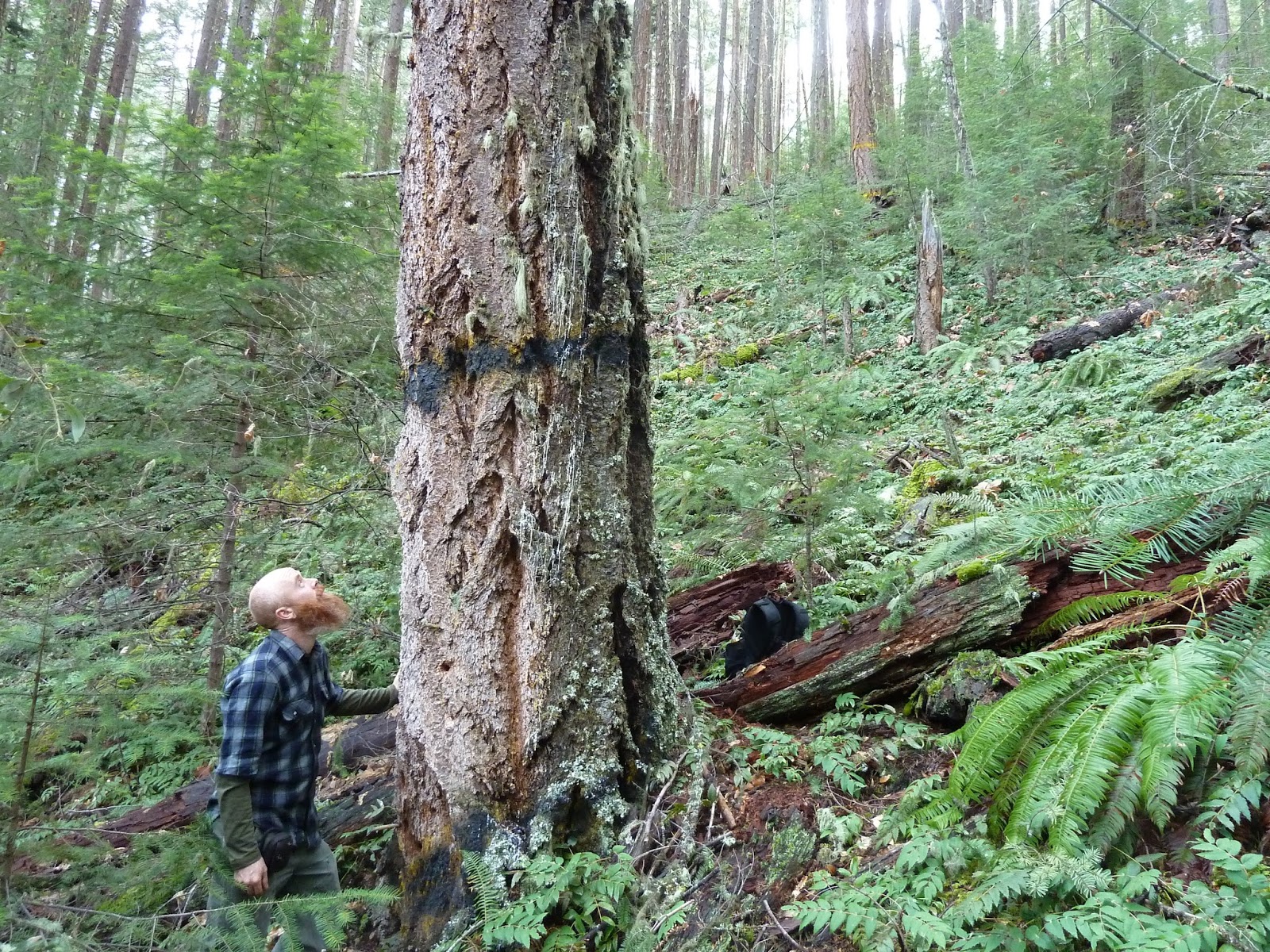
A 42" diameter tree marked for removal in unit 35-32 at the headwaters of Grouse Creek. The unit and the old trees marked within it are now approved for logging by the Medford District BLM.
The BLM Ignores the Community Alternative
Although the BLM claims to have blended "components from Alternative 4 and Alternative 5 [the Community Alternative]," (DR P.9 ) it is very difficult to understand exactly what components of the Community Alternative are approved for implementation. The BLM is apparently just playing lip service to the Community Alternative.

None of the basic principals of the Community Alternative, Alternative 5, will be implemented in the DR. 

  • Not a single unit will be treated with the detailed and scientifically valid prescriptions designed by the community in the Community Alternative
  • No prescriptions in commercial units approved in Alternative 4 will be modified in any way
  • No diameter limit will be implemented 
  • Canopy cover levels will be reduced far below those recommended in the Community Alternative
  • Roadless areas will be logged
  • New roads will be built in watersheds already suffering from high road density 
  • Riparian Reserves recommended for protection in the Community Alternative will be logged
  • Black plastic will be used to cover piles (only OR and NM allow for the burning of black plastic on burn piles)
  • There will be no altered prescriptions for unusual plant species, such as the snow bramble (Rubus nivalis), identified in the Community Alternative
Large Tree Retention
During the supposed collaboration with the Community Alternative Working Group (CAWG), metrics were developed and agreed upon by both the BLM and the CAWG. These metrics would inform and provide transparency to the decision making process. One of the key metrics was to quantify the number of large trees over 20" in diameter removed in timber sale units. The BLM did quantify large tree removal in the initial EA, and when community members identified that the number of large trees listed was highly inaccurate, the BLM addressed this significant error by issuing an errata with updated, yet still highly inaccurate information. 

In public comments to the initial EA, the Applegate Neighborhood Network (ANN) identified significant errors remaining in the analysis of large tree retention laid out in the BLM's errata. Based on on-the-ground field monitoring the estimate was that at least three times as many large trees were marked for removal than were analyzed in the BLM's Environmental Assessment.

The fact that the local Applegate community has performed more on-the-ground monitoring than the BLM to field check the amount of large trees being removed in the Nedsbar Timber Sale, and the fact that the BLM has had to admit that their numbers are so inaccurate, casts doubt on the BLM's ability to accurately quantify and analyze the amount of large tree removal in the DR. 

The BLM is using the numbers in the errata in their Final Environmental Assessment despite considerable doubt in regards to their accuracy. The BLM has simply not quantified the number of large trees to be removed in the majority of timber sale units. In addition, in the DR, they negate the importance of quantifying the number of large trees proposed for removal and they throw this agreed upon metric out the door, refusing to abide by their initial agreement to incorporate this analysis into the DR. 

The DR states, "there are no requirements that mandate the BLM to disclose the precise number of trees to be harvested of any diameter. Public disclosure and Agency consideration of the exact number of trees to be harvested is not necessary for a reasoned choice among alternatives for a project." (DR A-8)

The only alternative that clearly analyzed and quantified large tree removal in the Nedsbar EA was the Community Alternative, where no large trees over 20" in diameter would have been logged. The BLM has not provided accurate information regarding large tree removal in the Final EA or DR.


Fire Resilience and Fuel Reduction
The Community Alternative was focused on fire resilience and fuel reduction; however, the decision in the DR does not emphasize fuel reduction or fire hazard reduction in the Applegate Valley. The DR makes this clear: "Not all treatments are designed to reduce fire hazard. Forest thinning proposed under the Nedsbar Forest Management Project...does not aim specifically to address fire hazard." Instead, the BLM "chose the Selected Alternative as it best meets the 1995 RMP direction for timber resources." (DR A-3)

Field Manager Mastrofini said, "Based on my obligation to implement the intent of the 1995 Medford District RMP, I cannot select the community's Alternative 5 as designed, as it represents an unwarranted departure from the Timber Resources Objectives on the BLM's Resource Management Plan." (DR P.10 )


Clearly, one single objective dominates BLM land management: timber production.

Without specifically aiming to address fire hazard, the BLM is simply logging to benefit the timber industry at the detriment of the Applegate Valley and its residents. The Applegate will be left with increased fire hazards, degraded forests and forever altered wildland habitats after the implementation of the Nedsbar Timber Sale.

Unit 28-10A of the Nedsbar Timber Sale is located in the Bald Mountain Roadless Area and Jack-Ash Trail corridor. The stand includes large, old, closed canopy forest that is naturally resilient to fire, insects and disease. The area is in an important wildfire connectivity corridor and has been approved for logging by the Medford District BLM.

Roadless Areas and the Recreation Economy
A strong emphasis within the Community Alternative was the protection of citizen-identified roadless areas and the enhancement of economic values associated with outdoor recreation in the Applegate Valley. Unfortunately, the BLM will not address or emphasize these important community values in the DR.

Field manager Mastrofini explains her reasoning: "While BLM recognized these areas are important to the Community Alternative Working Group and the community members they represent...these areas do not meet the size criteria as defined in the...Wilderness Act to possess wilderness characteristics. The BLM is directed by the 1995 RMP to manage these areas for sustainable forest and timber production." (DR P.16)

Community values, a recreation economy, and roadless wildlands — supported by many throughout the region and beyond — are simply not considered in the decision framework outlined by field manager Mastrofini in the Nedsbar DR.

"Alternative 5 (the Community Alternative) was strongly influenced by the community's desire to preserve areas within the planning area as unmanaged. This aspect of Alternative 5 is inconsistent with the1995 RMP as the decision to manage these lands for timber production occurred in 1995." (DR P. 9)

New Road Construction
The Community Alternative proposed the development of no new roads; however, the BLM has approved 1.3 miles of "temporary" roads and 0.43 miles of new permanent roads, along with 7 new helicopter landings. Despite the fact that Applegate residents opposed it, a large section of new "temporary" road will be built within and adjacent to the Riparian Reserve on Lick Gulch. The BLM has admitted that this will contribute high levels of sediment to an already impaired stream with high road density. 
  
Temporary Good News With Lots of Work to Come
On a more positive note, 3 of the 25 controversial units identified by the community have been "deferred from treatment" and 4 others are now proposed for fuel reduction only. Unfortunately, BLM is making it clear that they still intend to log these units in the future. 

"It is important to note that my decision to implement the Selected Alternative for the Nedsbar Forest Management Project does not permanently defer timber harvest for those units not chosen for implementation at this time," Field Manager Mastrofini wrote in the DR. (DR P. 3)

In other words, the fact that these few controversial units have been dropped and/or altered in the sale is only temporary good news, and unfortunately our work is far from done — 450 acres in 18 controversial timber sale units have still been approved for logging!

We did it! BLM canceled unit 28-10B in the Bald Mountain Roadless Area; however, many units have been approved for logging in wild, fire resilient forest just like unit 28-10B. The agency admits in the DR, "not all units are designed to reduce fire hazard." Instead they "chose the Selected Alternative that best meets the 1995 RMP direction on timber resources." We need your help to save the last old, fire resilient forests in our region. Join us!

What You Can Do
Please consider contacting your local congressperson, state representative and regional BLM officials. Express your opposition to the Nedsbar Timber Sale and your support for Alternative 5, the Community Alternative. In the Applegate Valley we are ready for a new era of collaboration and conservation based management on public lands. Will the BLM join us? 

Applegate Neighborhood Network (ANN) and others will be filing a formal protest of this timber sale and will continue working for community and conservation in the Applegate Valley. Consider supporting their efforts with a donation. ANN is fiscally sponsored by KS Wild, please note that the donation is for ANN/Nedsbar.

Write An Official Protest

Anyone who wrote a comment for the Nedsbar Timber Sale Environmental Assessment (EA) can write an official protest of the Decision Record and Final EA. 


Contact Your Public Officials
Ron Dutton, State BLM Director
Senator Kevin Talbert
Sen.KevinTalbert@state.or.us
 Senator Merkely
https://www.merkley.senate.gov/contact
 
Representative Peter Buckley:
Rep.PeterBuckley@state.or.us
Sally Jewell, Secretary of the Interior:
exsec_exsec@ios.doi.gov
Senator Ron Wyden:
Representative Greg Walden


Below is a photo essay of a few of the Nedsbar Timber Sale units approved for logging by the Medford District BLM. 

Units 33-30 & 34-30

The units are located in the Boaz Mountain Roadless Area and include many large, old-growth trees. The stand is open spaced and naturally fire resilient. Unit 33-30 has been approved for "regeneration harvest," a form of timber management that has been shown to greatly increase fire hazards by "regenerating" young understory growth. The unit is located directly adjacent to the most densely populated portion of the Upper Applegate Valley. Unit 34-30 has been approved as a "group selection" unit. Both stands should be canceled. 

Units 33-30 & 34-30 on Boaz Mountain viewed from just above Star Ranger Station. Unit 34-30 has been approved for a "structural retention regeneration harvest," meaning the canopy will be reduced to roughly 30%. Unit 34-30 is a group selection cut, and according to BLM staff will look like "swiss cheese" when logging operations are finished.
Open, fire resilient forest conditions in unit 33-30. The stand will be logged to between 18 and 20 trees per acre. The "structural retention regeneration harvest" proposed in this stand will create increased understory density, contributing to an increase in fire hazards following logging treatments.
Unit 34-30 is a variable density, mid-seral stand with scattered old trees and fire resilient stand conditions. The entire stand of conifer trees in this photo is marked for removal. The removal of overstory canopy will increase fuel risks by creating dense understory fuel. Based on years of monitoring, local environmentalists have documented a vigorous "shrub response" filling in canopy gaps and heavily thinned stands, increasing fuel hazards and understory competition.


  Unit 35-32

Some of the largest trees marked for removal in the Nedsbar Timber Sale are located in unit 35-32. The stand is unusually moist for the Little Applegate watershed and includes the very uncommon snow bramble (Rubus nivalis), a plant species associated with moist forests and high canopy cover levels. The snow bramble growing in the dry foothills of the Little Applegate Valley is a disjunct population at the southern extent of its range. This unusual stand is approved for logging to 40% canopy cover. The BLM states in the DR: "R. nivalis's range is the west coast extending into Canada at higher elevations. The species is uncommon, but not rare, and does not require special attention under BLM policy." (DR )

True community collaboration would include plant buffers or deferred units for important ecological and/or botanical values identified by collaborative partners (i.e. the community). Snow bramble should be provided some special attention to maintain our internationally renowned biodiversity in the Applegate/Klamath-Siskiyou Ecoregion. Without attention to the unique needs of the landscape all claims of "restoration" are unjustified.  Without meaningful alterations to unit prescriptions for community-identified special plants, wildlife, or natural features, collaboration is insincere. 

Unit 35-32 at the headwaters of Grouse Creek contains many large, old trees and resilient stand conditions. All trees not marked yellow for retention would be removed under the DR signed by the BLM and canopy cover would be reduced to 40%.
The two large trees in the foreground are marked for removal in unit 35-32. Trees up to 42" in diameter are marked in the unit. In total, 145 trees over 20" in diameter are marked for removal on 27 acres, a rate of 19 large trees per acre. Canopy cover will be reduced to 40%, badly impacting a unique and disjunct population of snow bramble at the southern extension of its range.


Units 14-30 & 15-30

Located in the Buncom Roadless Area, these late-seral stands provides healthy, fire resilient conifer forest habitat within large stands of white oak and chapparal. Unit 15-30 was burned in a wildfire in 1987, creating open, fire resilient forest conditions. Both unit 14-30 and 15-30 should be canceled.

Unit 14-30 is located in the Buncom Roadless Area, just above the confluence of the Little Applegate and Applegate Rivers. The unit would be logged to 40% canopy cover, removing many large, old, fire resilient trees. The stand is open, spacious and supports very little understory fuel. Logging this stand will impact the area's roadless character, fire resilience and wildlife habitat.
Unit 15-30 sustained an understory fire in a 1987 wildfire and supports open, fire resilient conditions. It is a fire refugia within a sea of chaparral and will serve to moderate future fires. The BLM has targeted the stand for 40% canopy cover and will remove many large, old trees.


 Units 25-20, 25-21, 25-22 & 25-23

Located in the Trillium Mountain Roadless Area and in the viewshed of the Sterling Mine Ditch Trail, these units sustain healthy, fire resilient forests of dry Douglas fir and ponderosa pine. Unit 25-20 would include a new "temporary" road and helicopter landing pad in the Trillium Mountain Roadless Area. Units 25-20, 25-21, 25-22 & 25-23 should be canceled.

Unit 25-23 is a model for forest health in the Applegate Valley. This mixed stand is dominated by open groves of large, fire resilient trees. It is also located in the Trillium Mountain Roadless Area. The stand needs no treatment whatsoever, yet the BLM has approved logging groupings of large fir trees, some well over 30" in diameter.
A right of way will be cleared, a "temporary" road built to haul timber, and a helicopter landing pad will impact this wild, roadless ridge on Trillium Mountain. The new road and helicopter pad will be utilized to log the roadless northern face of Trillium Mountain above the Little Applegate River canyon.

Unit 28-10A, 28-11A, & 28-11B

Located in the Bald Mountain Roadless Area, unit 28-10A includes many of the timber sale's largest trees. 273 trees between 20" & 40" in diameter are marked for removal in unit 28-10A alone. The unit includes a diverse mixture of serviceberry, old-growth Douglas fir, moist mountain springs and rocky outcrops. The area is important connectivity habitat between low and high elevation habitats in the Little Applegate watershed and is important for wildlife migration.

 The stand in unit 28-10A is open, fire resilient and dominated by large, old trees, 273 of which are marked for removal. Trees marked white are marked for removal.

Unit 28-10A is some of the most beautiful forest in the Little Applegate River canyon. It also provides important connectivity habitat. The unit is likely the worst still included in the Nedsbar Timber Sale and should be canceled immediately to protect the roadless area's old forest habitat, scenic vistas and the recreation economy of the Applegate Valley.
Applegate Valley residents enjoy the backcountry of the Bald Mountain Roadless Area in Nedsbar unit 28-10A. Many large trees would be removed and canopy cover reduced to 40%. The logging will forever degrade some of the last intact, old-growth forest in the Little Applegate Valley.